
← Back: Sewing Machine Anatomy
The bobbin is the lower thread in sewing.
Without it, no stitch will form.
The stitch is created by the intertwining of:
- the upper thread (needle)
- the lower thread (bobbin)
If the bobbin is poorly prepared or incorrectly installed, the stitch will be unstable.
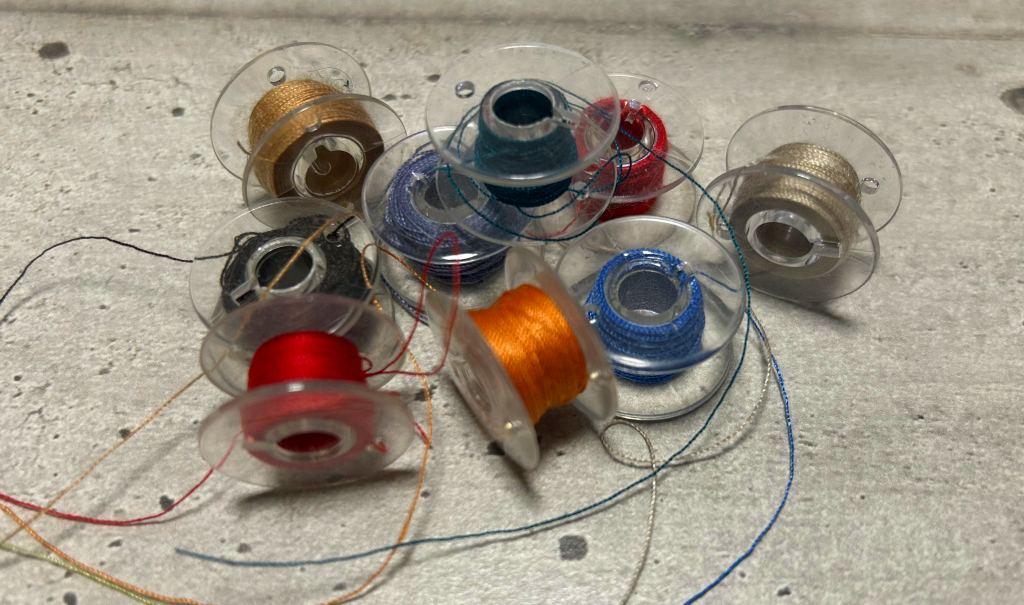
What is the bobbin for?
It provides the thread that knots with the upper thread.
The stitch forms when:
- the needle descends,
- a loop is created,
- the hook catches the thread,
- the bobbin completes the knot.
If the bobbin is incorrectly threaded → the knot does not form correctly.
The Importance of Tension
Tension must be balanced between:
- upper thread
- bobbin thread
An imbalance causes:
- loops under the fabric
- loose stitching
- puckered stitching
In most domestic machines,
bobbin tension is almost never adjusted.
The upper thread tension is adjusted.
How to wind your bobbin
How to install the bobbin and pull up the thread
the bobbin thread can be different from the main thread
This is useful:
- to differentiate right side / wrong side,
- to test tension,
- for technical sewing,
- to save time.
But for invisible stitching:
use the same color as the upper thread.
First signs of a poorly positioned or incorrectly threaded bobbin
- Significant loops under the fabric.
- Stitching that “eats” the fabric.
- Bobbin thread showing on the right side.
- Unusual noise.
- Thread jamming from the first stitches.
In 80% of cases:
the problem comes from incorrect threading, not a mechanical adjustment.
Key Takeaways
The bobbin is not a minor detail.
A bobbin that is:
- well-filled,
- correctly installed,
- threaded in the right direction,
guarantees a stable stitch.
Before touching any settings, always check the threading.
← Previous lesson
The needle
Next lesson →
The thread

