
This step helps you understand in practical terms what elastic does.
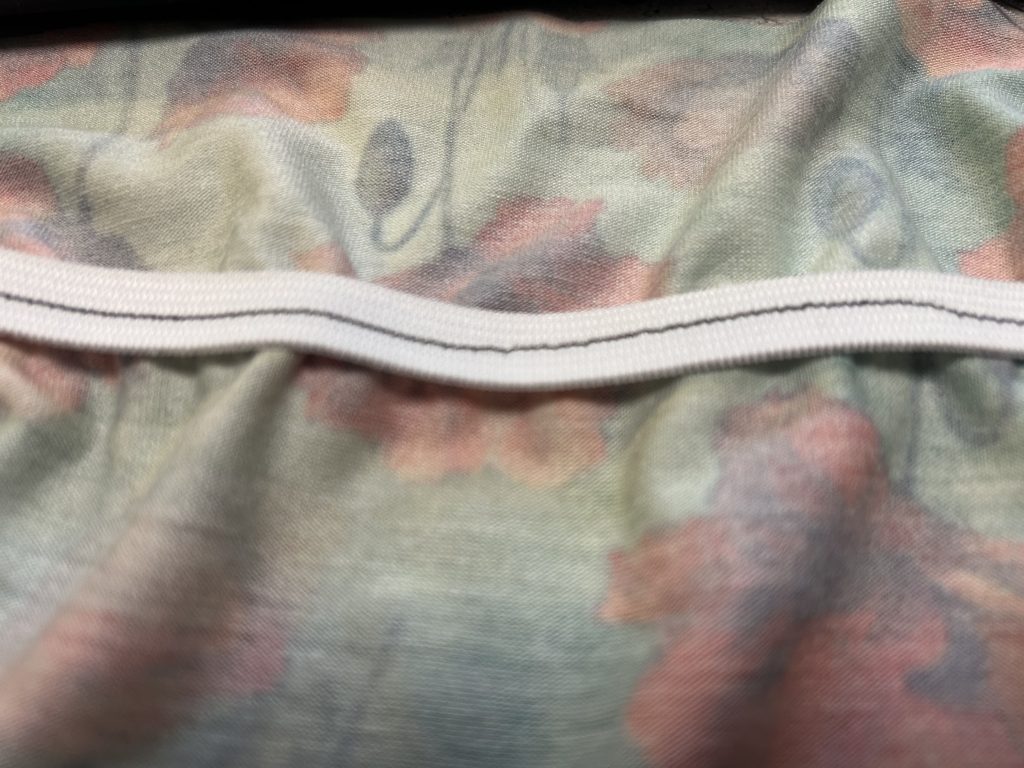
Here, the goal isn’t to make a waistband yet, but to see the direct impact of tension on the fabric.
It’s the foundation of working with stretch fabrics.
🔹 Principle
Use an elastic shorter than the fabric to create gathers.
👉 The fabric stays stable
👉 The elastic is stretched while sewing
It’s this difference that creates the result.
🔹 Technical exercise
Prepare
- Cut a strip of fabric
- Take elastic by the metre
Sew
- Position the elastic on the fabric
- Place under the presser foot
- Lower the needle
Start slowly, then:
- Apply light, steady tension to the elastic
- Let the fabric feed through without pulling it
👉 The fabric must not move
👉 Only the elastic is put under tension
Guiding help
Use washi tape or a marker on the machine to:
- Keep the tension consistent along the entire seam
- Avoid compensating with your hands
- Sew straight
👉 Guiding replaces rough, approximate corrections
🎥 watch and learn the motion
⚠️ Watch points
- Pulling the fabric → distortion, or even tearing the elastic
- Uneven tension → uneven gathers
- Going too fast → loss of control
👉 Consistency is more important than speed
🎯 Skill acquired
✔️ Understand the impact of tension
✔️ Know how to stretch elastic in a controlled way
✔️ Stabilize fabric while sewing a stretch seam
🔗 Real-life example
Direct application in the Vega Tunic pattern:
A simple tunic with decorative gathers at the waist.

Tunique Vega
La Tunique pour la plage… ou la nuit.
Maille légère, encolure propre, dentelle au kilomètre.
🎥 Tutoriel vidéo gratuit inclus
← Previous lesson
Understanding how elastic works
Next lesson →
Elastic sewn in, turned, and topstitched

