
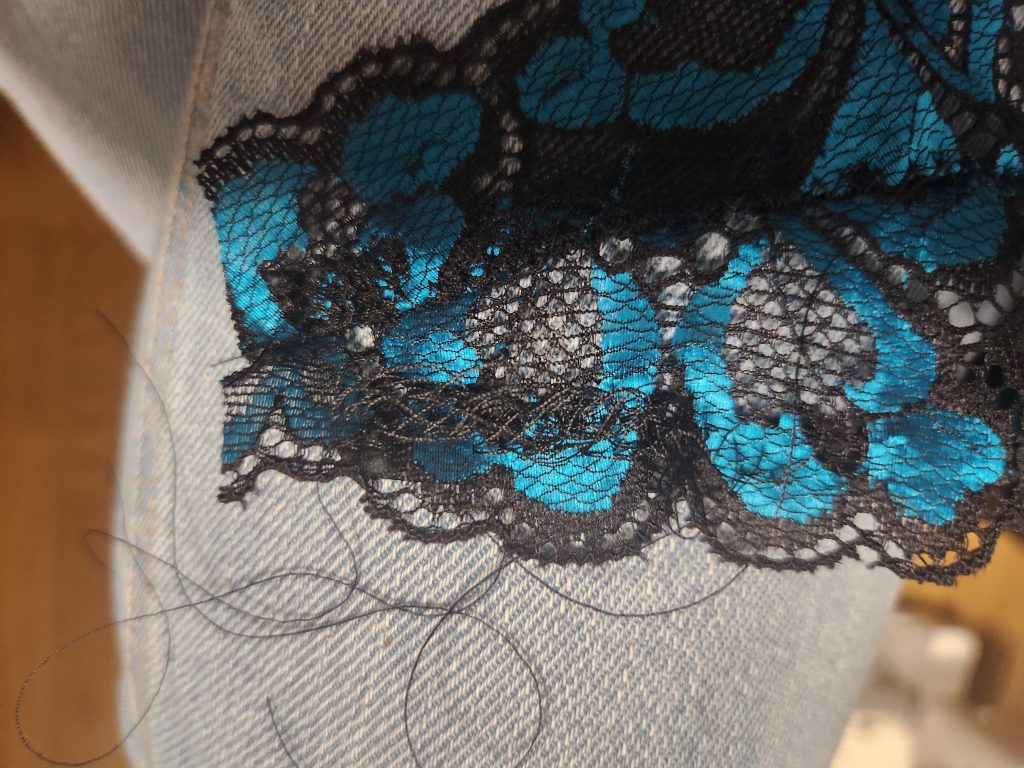
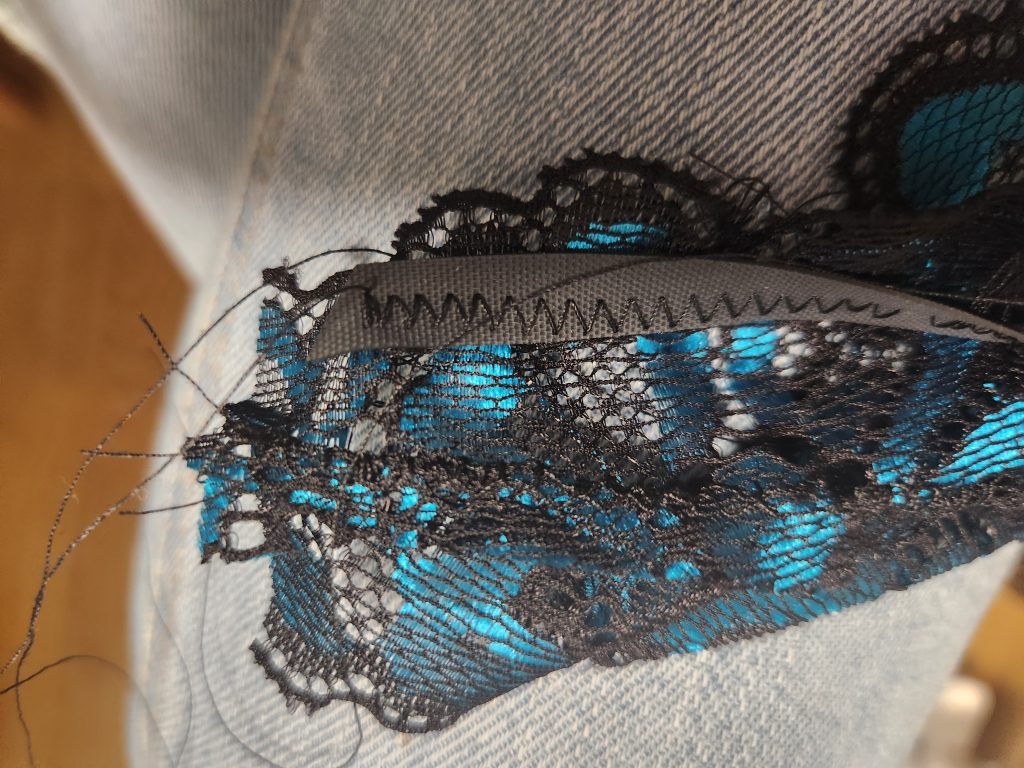
When you apply clear elastic or elastic to a fabric and it jams underneath, the stitch becomes irregular, or it bunches up, the cause is almost always the same: a tension problem with the upper thread, triggered during threading.
Even if you have threaded your machine 1,000 times, it only takes one wrong pass to cause this type of glitch.
1. The telltale sign: the needle thread is not taut
Before blaming everything (the clear elastic, the fabric, the machine, the stitch…), check this very simple point:
➡️ Gently pull on the needle thread.
If it comes out too easily, without clear resistance → the thread is not in the tension discs.
And if the upper thread is not properly tensioned, it no longer controls the clear elastic or the elastic.
Immediate result:
- jamming under the fabric,
- gathering,
- bunched-up zigzags,
- clear elastic that “slips back” while the fabric moves forward.
This is a key diagnostic.
2. Why it happens: the habit trap
When you know your machine by heart, you thread it mechanically.
The problem is that threading too quickly makes you miss THE essential step:
➡️ The path between the tension discs (usually just behind the adjustment dial).
If the thread doesn’t go properly between the discs, the machine sews… but without real tension.
On fabric alone, you might get away with it.
On clear elastic or elastic, it’s a guaranteed disaster.
3. The basic rule (that we forget because we’re in a hurry)
For tension to be applied correctly:
✔️ 1. Always thread the machine with the presser foot up
Foot up = discs open → the thread can enter.
Foot down = discs closed → the thread stays outside → zero tension.
✔️ 2. Take the time to push the thread into the discs
Never just “slide it in front.”
You push slightly until you feel the thread click into place.
✔️ 3. Pass through every guide in order, without skipping any
Even one missed guide changes the final tension.
✔️ 4. Check by pulling lightly on the thread at the end
- Clear resistance → active tension → OK.
- Thread too loose → re-thread → DO NOT sew.
These rules are not “for beginners.”
They are mandatory, even after twenty years of sewing.
4. Why clear elastic highlights everything
On normal fabric, imperfect tension can go unnoticed.
But on clear elastic (or regular elastic):
- rigid material,
- moves slower than the fabric,
- requires precise control of the upper thread.
As soon as the tension is low → the fabric moves, but the elastic doesn’t → this creates jams and bunching.
5. Summary
- If the needle thread is not taut, it is definitely a threading problem.
- The thread must pass between the tension discs with the foot up.
- Jams under the fabric with clear elastic or elastic almost always come from missing or poorly applied upper tension.
- Re-threading properly fixes 90% of cases.
- Even if you know your machine, you must follow the basic rules: foot up, discs open, thread pushed inside.

